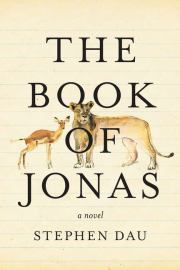
The Book of Jonas by Stephen Dau

‘What is it like to lose everything”? This is the opening question in this  debut fiction book written by Stephen Dau called The Book Of Jonas. Younis is is a 15 year old boy who has lost his village, family and country. He survives the  destruction of his village and is saved by an American soldier. Younis eventually is granted “haven” in the USA with a foster family and changes his name to Jonas.

The sparse prose details the loss, the assimilation and diaspora of this refugee who lives in America, so far away from his homeland.The recovery of his lost memory is guided by his court ordered therapist and by the introduction to the mother of the soldier that saved his life. The mother, Rose, is desperate to find out what happened to her son who went missing after the fight. She wants to know what he can remember and Younis / Jonas is reluctant, and resistant to remember. He has a secret and the book marches the reader to this past that holds the key to his memory. The mystery of the missing soldier, the traps of memory  and the fallout of war are covered in this novel. Also note the story told about the lion and the baby gazelle, a metaphor for the comfort and cruelty of life.Dau does an excellent job of conveying the disconnect for Younis and I am haunted by his story. And that is my 2 cents…


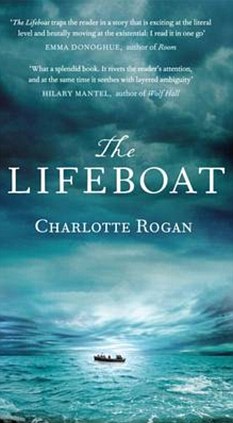
The Lifeboat by Charlotte Rogan

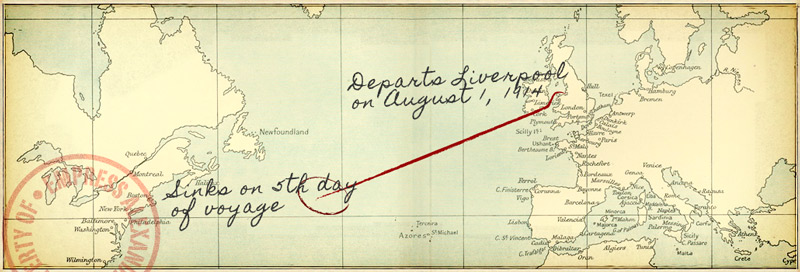
The Life Boat by  Charlotte Rogan just happens to be published at the  100th anniversary of the sinking of the Titanic. There are some similarities in this story to the Titanic as this is also about a luxury liner crossing the Atlantic in 1914 and it sinks. The story departs from the Titanic at the sinking and forks to a different story line- the survivors on an overcrowded lifeboat and the choices that are made. When the Titanic sank, all survivors in lifeboats were picked up within six hours, not true for this ship, the Empress Alexandra, whose survivors wait almost 21 days for rescue and the drama that unfolds is what captures the reader.

Told by 22 year old Grace who through manipulation and good fortune has married a wealthy man to flee her circumstances of poverty. Her husband Henry’s last act is forcing a place for Grace on an overcrowded lifeboat. Grace narrates the events on  Lifeboat  14 as they wait to be rescued.  The passengers on Lifeboat 14  face decisions for survival and  sacrifice for the good of the whole.  At first  John Hardie , one of the crew from the ship, takes charge of the boat by redistributing the weight in the overcrowded boat, and instructing the  passengers to row. Yet, his directions don’t stop there.  A disturbing image is his decision to abandon adults and a child to certain death in the ocean, in some cases beating them to stay away from their lifeboat, while the passengers protest yet remain passive. The choices become more personal as Hardie has men draw straws for who must sacrifice their life by jumping off the lifeboat so  food and space could be provided for the remainder- killing some for the good of the others. What choice would you make if you were in their situation? Are you guilty if you don’t stop an act of murder?

“Grace realizes that her survival could depend on whether she backs the ruthless but experienced John Hardie or the enigmatic but increasingly forceful Ursula Grant. Over the course of three perilous weeks, the lifeboat passengers plot, scheme, gossip and console one another while questioning their deepest assumptions about goodness, humanity and God” ( Rogan, The Lifeboat, 2012 ). As the lifeboat drifts at sea, the desperation, doubt and fear drive the survivors into a mutiny, those who act and those who remain  silent and thus complicit, as a murder takes place.

“Grace is finally rescued, only to be put on trial for her life. Unsure what to make of their client, Grace’s attorneys suggest she write her story down. The result is a page-turning tale of moral dilemmas, and also a haunting portrait of a woman as unforgettable and complicated as the events she describes” ( Rogan, The Lifeboat , 2012).

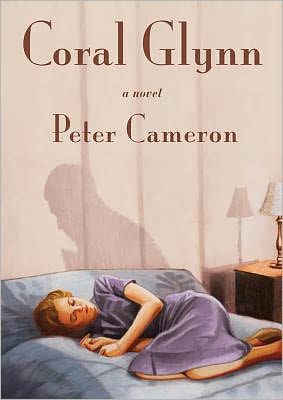
Coral Glynn by Peter Cameron

I have had a busy week- I read 4 new books and want to tell you all about them. Here is the first pick for you to read…..

Coral Glynn by Peter Cameron is definitely a book to read…think Daphne du Maurier meets  Jane Eyre in the 1950’s . This fascinating story is about Coral, a private nurse, hired  to take care of the matriarch who is dying of cancer in this small English town. The isolated house is contaminated by bitterness, loneliness and loss from the people who dwell there. Mrs. Prence, the housekeeper, is a cranky old woman who tries to make trouble for Coral, and Major Clement Hart, the son,  is a lonely WWII veteran who is unmarried, has a limp and carries wounds from the war and  life.

The themes of loss, repressed homosexuality, and partial truths or ” lies of omission” permeate the landscape of this story. I don’t want to give too much away but each character’s personal history is withheld and revealed at moments that makes you want to scream instructions to each character- like “don’t do that” or “tell them the information”- a bit maddening for the reader on the sidelines. There is a scene where Coral walks in the forest and sees children doing something that leaves you horrified when she walks away. Or witness the time that Coral purchases a dress and is so frustrated by the impossibility of zippering herself up that she storms back to the dress shop to return it.

I was incredulous at some of the behaviors of the characters but I was hooked on the story- I had to find out what happens. The writing is rich with imagery. One reviewer said it best: “by the end of this absorbing story of love missed, love lost, love found, I was thinking that this must be what it’s like to slip into a bath of hot tears “( NY Times Book Review, Dominique Browning, March 16, 2012). I agree. The book did not lead me to where I thought the characters would end up and I liked the pleasant surprises. That’s my 2 cents.

Someone Knows My Name by Lawrence Hill & Escape from Slavery by Francis Bok

Slavery still exists, both in the past and in the present. The first  book to read is one from my 2010 book list that is worth revisiting. Someone Knows My Name by Lawrence Hill is steeped in facts about slavery in America and some information was completely new to me: the establishment of a colony of freed slaves, Black Loyalists, in Nova Scotia with the help of the British during the war between the Colonies and King George. Did anyone out there know that?  Hill tells this important history through Meena, an African woman, who recalls her experiences of slavery and freedom to abolitionists in London.
Kidnapped from Africa as a child, Aminata Diallo ( Meena) is enslaved in South Carolina, but escapes during the chaos of the Revolutionary War. She tells her story from the days of growing up with two loving parents in a small village ( in what is now Mali) then her capture by another tribe and sold to whites on the African coast. Her recounting of the slave ship and the arrival in America is detailed and very sad. Eventually she finds “freedom” in Manhattan, she becomes a scribe for the British, recording the names of the blacks, The Book of Negroes, who have served the King and earned their freedom in Nova Scotia. But the hardship and prejudice of the new colony prompt her to follow her heart back to Africa, then on to London, where she testifies about  the injustices of slavery, her life story and helps the abolitionist movement in Britain. It is a story that no listener, and no reader, will ever forget!  ( From Freedom to Slavery, by Nancy Kline, NY Times Review, Jan. 20, 2008).

But if you think slavery is a part of the past, please read the next recommendation! Escape from Slavery by Francis Buk is his account of enduring 10 years of slavery in the Sudan. It is a riveting narrative and heartbreaking. I read his book before I heard him speak at  Marin Catholic High School . He is a gentle, very humble, man who chooses not to forget those who still remain in slavery into today’s modern world.  Francis Buk is one of my heroes. He  bears witness to the slavery that exists today and is committed to ending it.

Seven Year old Francis Piol Bol Buk was living with his family on a farm in southern Sudan. One day in 1986, he was sent by his mother to sell eggs and peanuts in the marketplace. There in a slave raid, he was kidnapped from his contented life and thrown into a difficult, horror filled existence in slavery by rich Muslim Arab farmers in Northern Sudan. Buk’s family was  murdered during the raid. He lived in a barn with animals for ten years and forced to work for the owners. He escaped at age 17, and made his way to Cairo and became a UN refugee. He was resettled in the U.S. in 1999. He adjusted to life in US but could not forget the life he left behind in the Sudan. The persistence of slavery in the modern world can’t be ignored and Buk is committed to helping free slaves and free southern Sudan from the Arabs in North Sudan. Buk worked with an American antislavery organization and testified before Congress about the atrocities in the Sudan. Now Francis Buk is working on building a school in the new southern State of Sudan and ending slavery.

Today the estimates for slavery is upwards of twenty-seven million people which includes- child labor, human and sex trafficking, forced labor and chattel slavery. Slavery exists in Haiti, Sudan, Nigeria, Pakistan, Thailand to name a few, and many other places in the  world. America and Europe contribute to slavery by ignoring or purchasing from groups/ countries that benefit from slavery’s economy.(map) Thank you  Francis Buk, Aminata Diallo  and Lawrence Hill for sharing your history and stories. And that is my 2 cents for today, Tracy.